J.W. Crawford Management
The Unbound Entrepreneur
5 Phases. 21 Core Elements. (A Guided Success System)
Most entrepreneurs don't start a business to create another job for themselves.
They start because they want greater control over their income, their time, their decisions, and ultimately their future. Yet as a business grows, something unexpected often happens: the owner becomes increasingly important to its daily operation.
More customers create more demands. More employees create more management. More revenue creates more complexity. Before long, the person who created the business can become the person holding nearly every important part of it together.

The Unbound Entrepreneur
Is designed to address that problem.
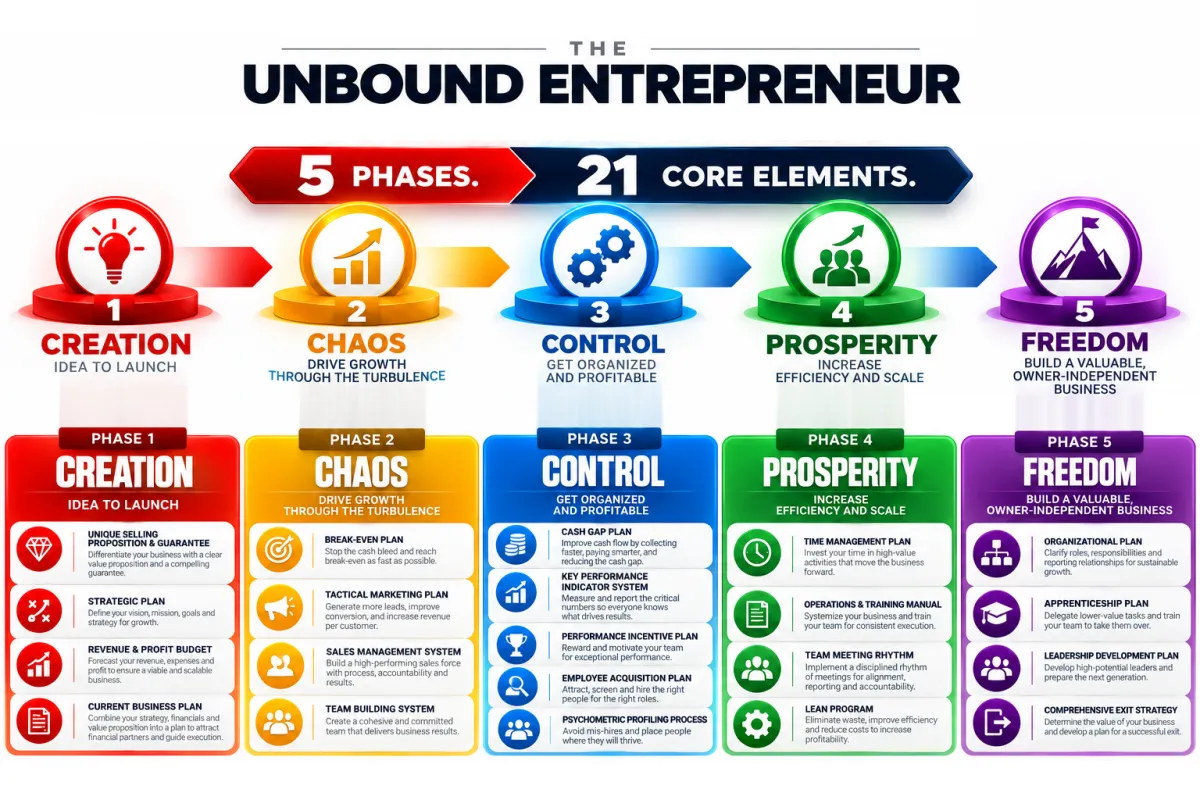
It provides a practical framework for understanding where a business is today and identifying what needs to be built, improved, or strengthened next. The framework consists of 5 Phases and 21 Core Elements, with each Element connected to a specific phase of business development.
The purpose is not to implement all 21 Core Elements at once. It is to identify the phase that best represents the current condition of the business, then concentrate on the Core Elements that address the challenges associated with that phase.
Business has a natural progression:
Creation → Chaos → Control → Prosperity → Freedom
Each phase represents a different set of business priorities. Creation establishes the model. Chaos focuses on survival and traction. Control brings financial and operational discipline. Prosperity develops efficiency and infrastructure. Freedom builds an organization capable of operating with significantly less dependence on its owner.
Phase 1: Creation
The Creation Phase is where the business model takes shape.
Although this phase naturally applies to startups and pre-revenue businesses, established companies can return to Creation when market conditions change enough that the existing business model must be reconsidered.
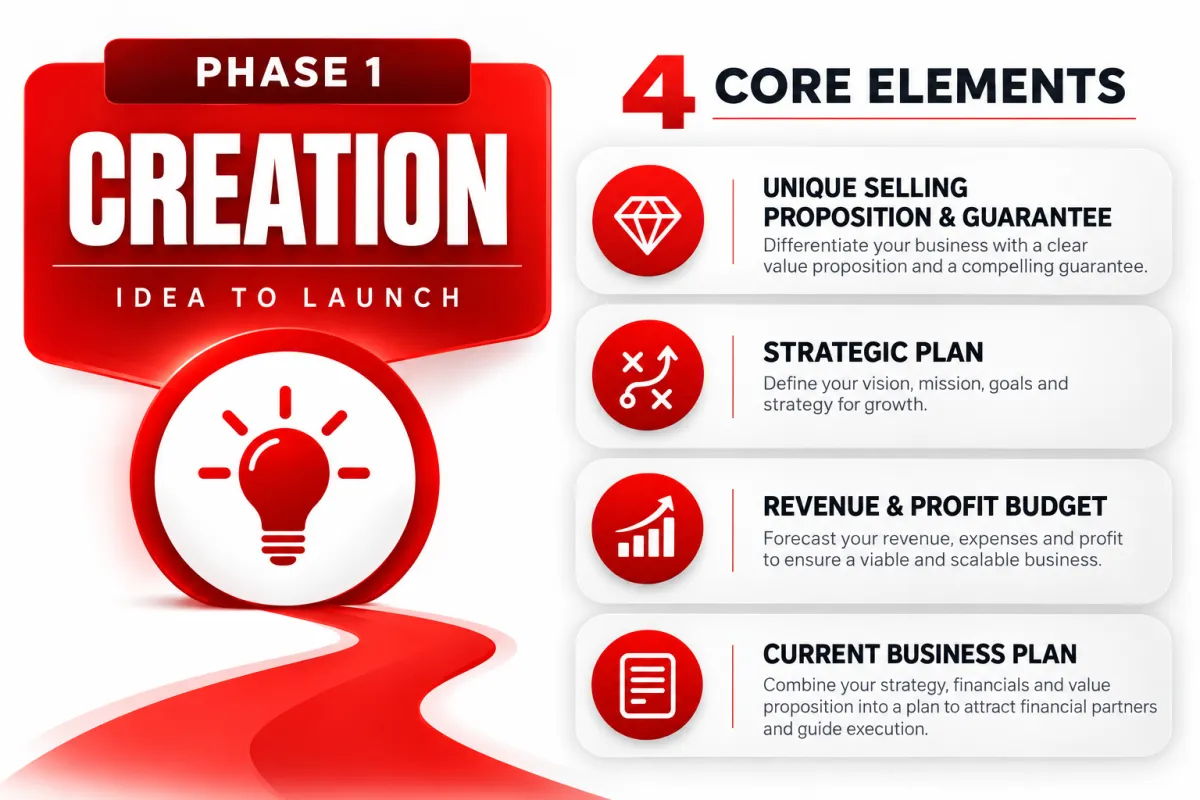
The objective is to identify a viable long-term market position and establish the financial and strategic foundation necessary to pursue it. The four Core Elements are Unique Selling Proposition and Guarantee, Strategic Plan, Revenue and Profit Budget, and Current Business Plan.
Element 1: Unique Selling Proposition and Guarantee
A business needs a compelling reason for customers to choose it instead of its competitors.
The Unique Selling Proposition, or USP, defines that difference. The guarantee strengthens the proposition by reducing some of the perceived risk associated with choosing the company.
When businesses consistently compete on price, struggle to communicate their value, or appear interchangeable with competitors, the underlying problem may be insufficient differentiation.
This Core Element therefore begins with a basic question:
Why should the ideal customer choose this business instead of the alternatives?
The answer must be more substantial than better service, higher quality, or greater experience if competitors can make the same claims.
The curriculum connects this concept to the diffusion of innovation model—innovators, early adopters, early majority, late majority, and laggards—to illustrate how businesses can become commoditized as markets mature. The goal is to establish and clearly communicate meaningful differentiation rather than becoming another provider competing primarily on price.
Once that differentiation is established, it must be communicated effectively. The framework uses the familiar AIDA structure—Attention, Interest, Desire, Action—to turn the business's value proposition into a message that attracts attention, maintains interest, creates desire, and leads toward action.
Element 2: Strategic Plan
Differentiation answers the question of why customers should choose the business.
Strategy answers another question:
Where is the business going?
The Strategic Plan establishes the company's vision, mission, values, goals and measures of progress.
Rather than becoming a document that is written once and forgotten, it should evolve as the business evolves. The framework incorporates strengths and weaknesses, opportunities and threats, core values, purpose, three-to-five-year targets, annual goals, quarterly actions, KPIs and the company's brand promise.
The result is alignment. Owners, managers and employees gain a common understanding of what the organization is trying to accomplish and what matters most right now.
Element 3: Revenue and Profit Budget
Strategy has to connect to financial reality.
The Revenue and Profit Budget forecasts revenue, variable costs, fixed costs, owner compensation, profit and the working capital necessary to operate the business.
Instead of simply discovering whether the company made money after the month or year has ended, the owner develops a forward-looking financial picture.
The budget should extend at least 12 months so the owner can anticipate profitability and cash requirements before they become problems.
Element 4: Current Business Plan
The Current Business Plan brings the previous Creation elements together.
It incorporates the company's value proposition, strategy and financial projections into a credible description of how the business intends to operate and grow.
This becomes especially important when the company is making major decisions, raising capital, securing financing, investing in technology, restructuring, or communicating its business model to financial partners.
Creation establishes the foundation.
Then comes the difficult part: proving that the business can survive.
Phase 2: Chaos
Business is moving, but movement does not necessarily mean stability.
The owner may be investing significant amounts of time and money while aggressively trying to create growth. Sales may exist while profitability remains elusive. Cash enters the business and disappears just as quickly.
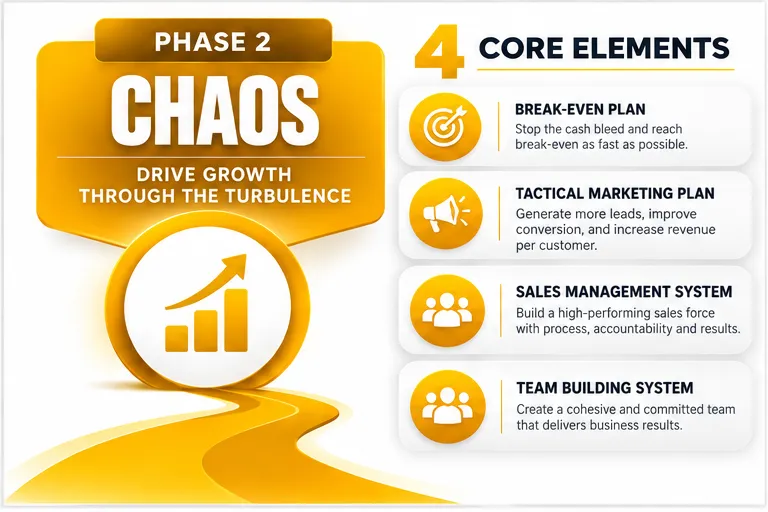
The four Core Elements of this phase are Break-Even Plan, Tactical Marketing Plan, Sales Management System, and Team Building System.
Element 5: Break-Even Plan
Before pursuing ambitious growth, a struggling business must first stop losing cash.
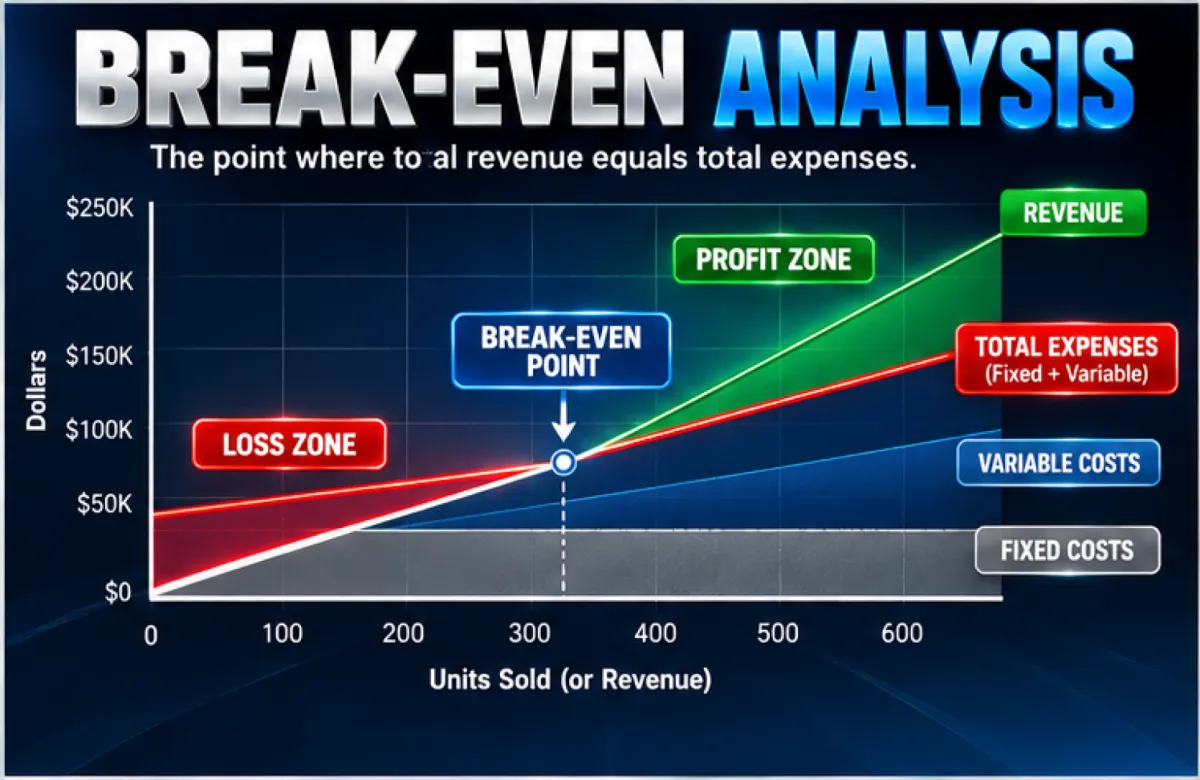
Break-even is the point at which revenue equals total expenses. Understanding that point allows the owner to convert an abstract objective—“we need more sales”—into measurable revenue and unit targets.
The Break-Even Plan attacks the problem from multiple directions: reducing unnecessary fixed expenses, controlling variable costs and increasing revenue.
Once the break-even requirement is calculated, it can be translated into monthly, weekly and daily sales targets.
Element 6: Tactical Marketing Plan
Once the business understands the sales required to reach break-even, it needs a measurable way to produce them.
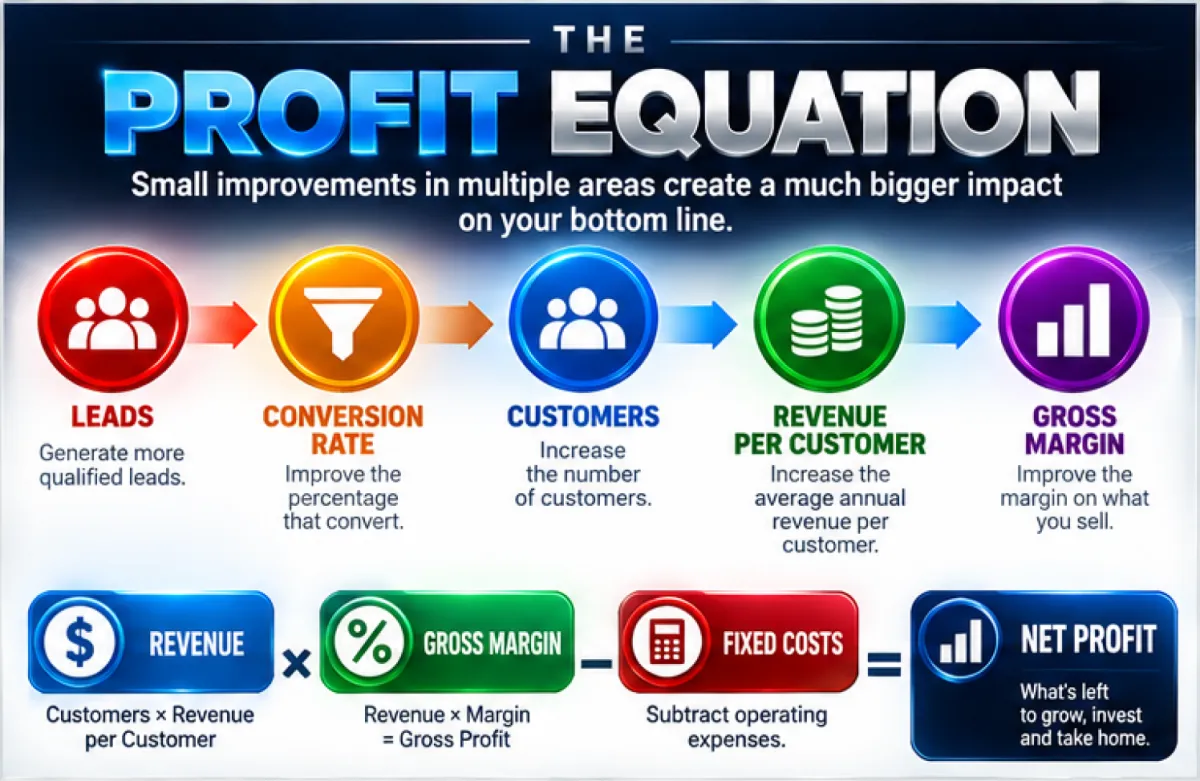
The Tactical Marketing Plan focuses on several financial and marketing levers: leads, conversion rate, customers, annual revenue per customer, gross margin and ultimately net profit.
The important idea is that profitability is interconnected. Improving several business drivers simultaneously can create a much larger effect than concentrating on only one.
Element 7: Sales Management System
Marketing generates opportunities. Sales must convert them.
The Sales Management System creates a repeatable structure for managing sales activity through scripting, CRM tracking, performance measurement and accountability.
The framework organizes sales development around the Three A's: Attitude, Activity and Acumen. Salespeople need the appropriate mindset, sufficient levels of productive activity, and the skills necessary to convert opportunities into customers.
Element 8: Team Building System
Eventually, growth exceeds what the founder can personally accomplish.
The Team Building System focuses on creating a cohesive team capable of producing results together. The curriculum draws on Patrick Lencioni's framework, emphasizing trust as the foundation for productive conflict, commitment, accountability and results.
The objective is not simply to employ more people. It is to build a team capable of moving the company beyond Chaos.
Phase 3: Control
Positive cash flow is a major milestone, but it introduces a new danger: careless growth.
A company can finally become profitable and then consume that profitability through unnecessary overhead, inefficient hiring and poorly managed expansion.
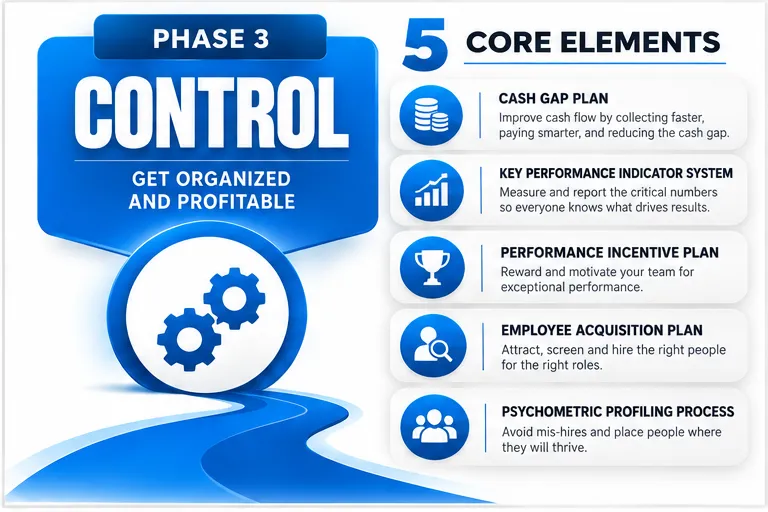
The Control Phase is about introducing discipline while growth is occurring. Its five Core Elements are Cash Gap Plan, Key Performance Indicator System, Performance Incentive Plan, Employee Acquisition Plan, and Psychometric Profiling Process.
Element 9: Cash Gap Plan
Profit and cash are not the same thing.
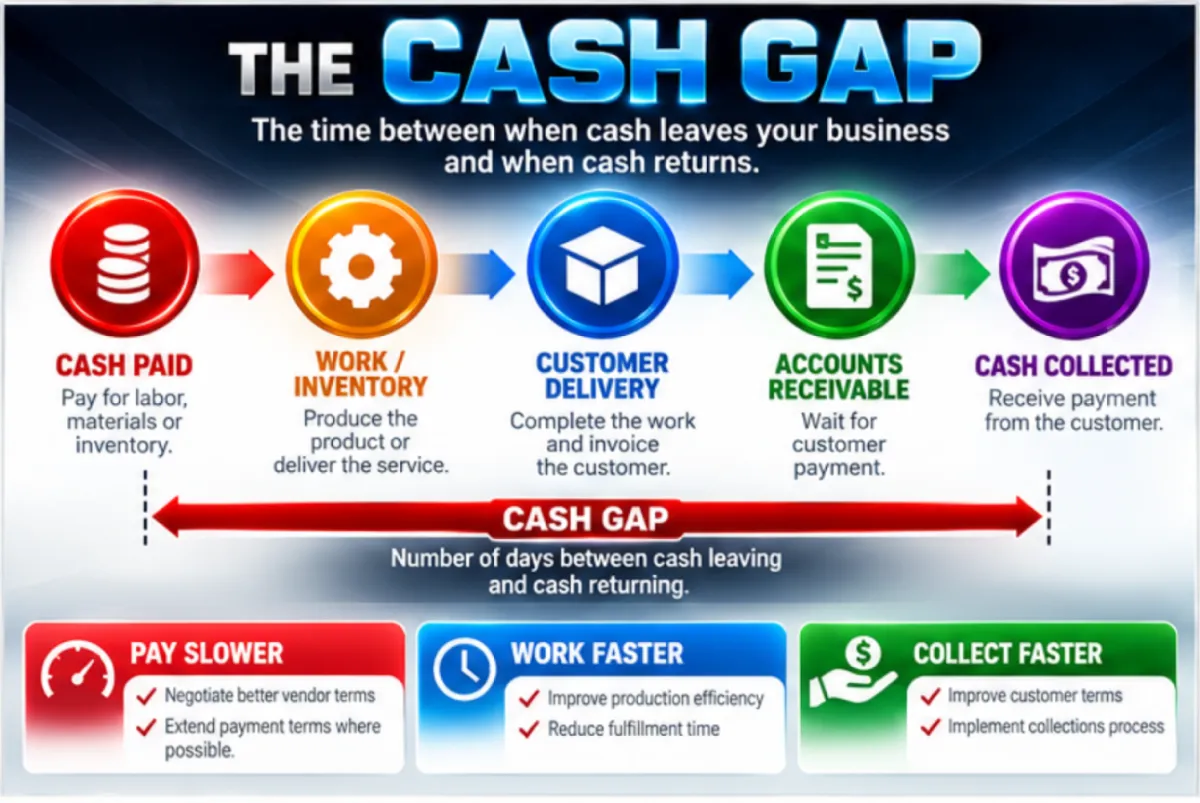
A company can make profitable sales and still experience a cash shortage because money leaves the company before customer payments arrive.
The period between paying cash to fulfill the work and collecting cash from customers creates the cash gap. The objective is to shorten that gap through faster collections, improved customer terms and better vendor terms.
Element 10: Key Performance Indicator System
Once a company has employees performing different functions, the owner needs objective ways to know whether those functions are producing the desired results.
KPIs translate performance into numbers.
Different positions require different measurements, but the principle remains the same: team members should understand what is being measured, why it matters and how their individual performance affects the business.
Element 11: Performance Incentive Plan
Measurement becomes more powerful when employees have a meaningful connection to the results.
The Performance Incentive Plan connects compensation to defined performance outcomes, creating an opportunity for employees to increase their earnings when exceptional results are produced.
Element 12: Employee Acquisition Plan
A growing company needs a repeatable process for finding capable people.
The Employee Acquisition Plan treats recruiting as a process rather than an occasional reaction to an open position. The framework moves through generating candidates, screening them, conducting interviews and evaluating candidates through a practical test-drive process.
Element 13: Psychometric Profiling Process
Hiring someone who can perform a job is only part of the challenge. The person also needs to fit the demands of the role.
The curriculum uses the Everything DiSC Workplace Individual Profile to examine four primary behavioral styles—Dominance, Influence, Steadiness and Conscientiousness—along with workplace priorities such as action, enthusiasm, collaboration, support, stability, accuracy, challenge and results.
The objective is straightforward: improve the probability of putting the right people into the right roles.
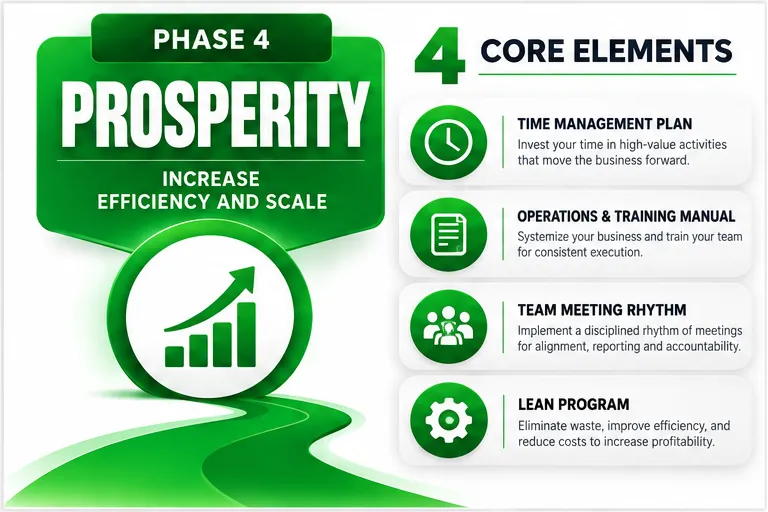
Phase 4: Prosperity
Prosperity begins when the business has moved beyond simply producing positive cash flow and begins developing the infrastructure required for sustained performance.
The company is becoming something larger than the owner's individual effort.
The emphasis shifts toward efficiency, documentation, communication and reducing waste. The four Core Elements are Time Management Plan, Operations and Training Manual, Team Meeting Rhythm, and Lean Program.
Element 14: Time Management Plan
At this level, the owner's time becomes one of the company's most valuable resources.
The Time Management Plan begins by identifying where time is actually being spent and then intentionally reallocating it toward higher-value activities.
The framework uses a time study, Stephen Covey's time management matrix and a default calendar to create a deliberate “time budget” for the owner.
Element 15: Operations and Training Manual
A company cannot reduce dependence on specific individuals if critical knowledge exists only inside their heads.
The Operations and Training Manual turns that knowledge into documented processes.
Tasks are identified, prioritized and documented using written instructions, photographs and videos so other team members can be trained to perform them consistently.
This is a critical transition from people-dependent execution to process-supported execution.
Element 16: Team Meeting Rhythm
Systems require communication.
The Team Meeting Rhythm establishes recurring meetings at appropriate intervals—annual, quarterly, weekly and daily—to support planning, alignment, reporting and accountability.
Rather than adding meetings for the sake of meetings, each rhythm should have a defined purpose.
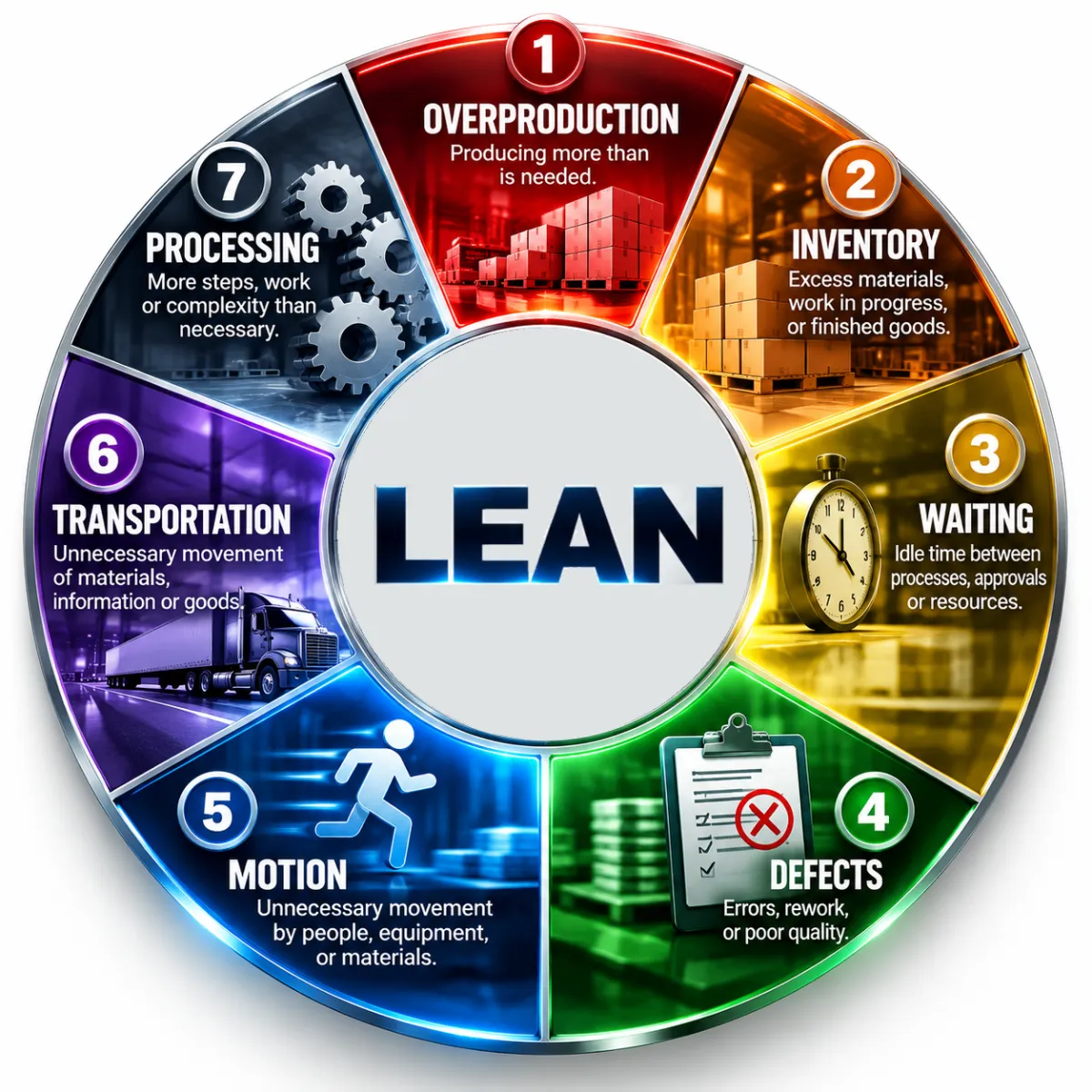
Element 17: Lean Program
Growth often creates waste.
Processes become unnecessarily complicated. Employees wait for information. Materials move unnecessarily. Errors create rework. Inventory accumulates.
The Lean Program focuses the team on identifying and eliminating muda, or waste. The curriculum identifies categories including overproduction, inventory, waiting, defects, excess motion, transportation and processing, and uses kaizen meetings to encourage ongoing improvement.
Phase 5: Freedom
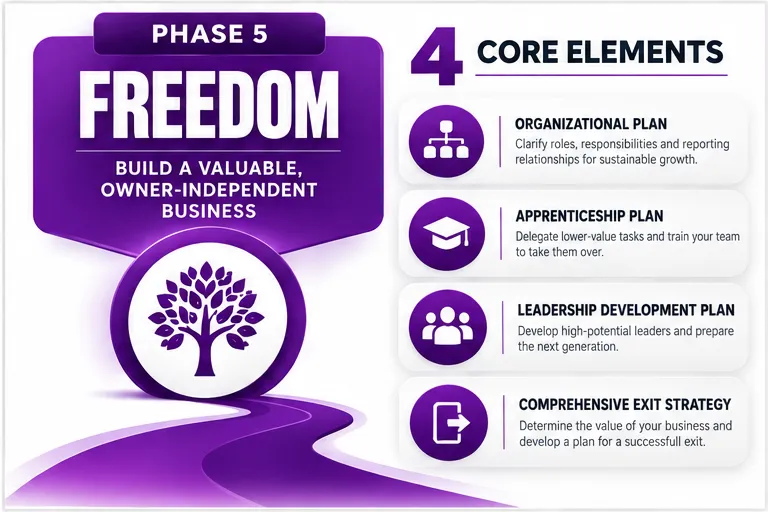
Freedom is the final phase because the business is no longer designed around the assumption that the owner must personally remain at the center of everything.
The business has meaningful cash flow, management capability and leaders who can assume increasing levels of responsibility. That gives the owner more choices: continue operating the company, pursue additional opportunities, acquire businesses, transition leadership, sell the company, or simply reduce personal involvement.
The four Core Elements are Organizational Plan, Apprenticeship Plan, Leadership Development Plan, and Comprehensive Exit Strategy.
Element 18: Organizational Plan
As companies grow, unclear responsibility becomes expensive.
The Organizational Plan establishes reporting relationships, organizational structure and job responsibilities so everyone understands who owns what.
The process includes mapping the company's workflow, developing an organizational chart, defining positions and beginning to move lower-value responsibilities away from the owner
Element 19: Apprenticeship Plan
Delegation is not simply assigning a task to another person.
The person receiving the responsibility must be trained until they are capable of performing it without constant intervention from the owner.
The Apprenticeship Plan identifies lower-value activities currently occupying the owner's time, determines who should assume them and uses a four-step apprenticeship process to transfer responsibility.
Element 20: Leadership Development Plan
Eventually, delegating tasks is not enough.
The company needs people who can lead.
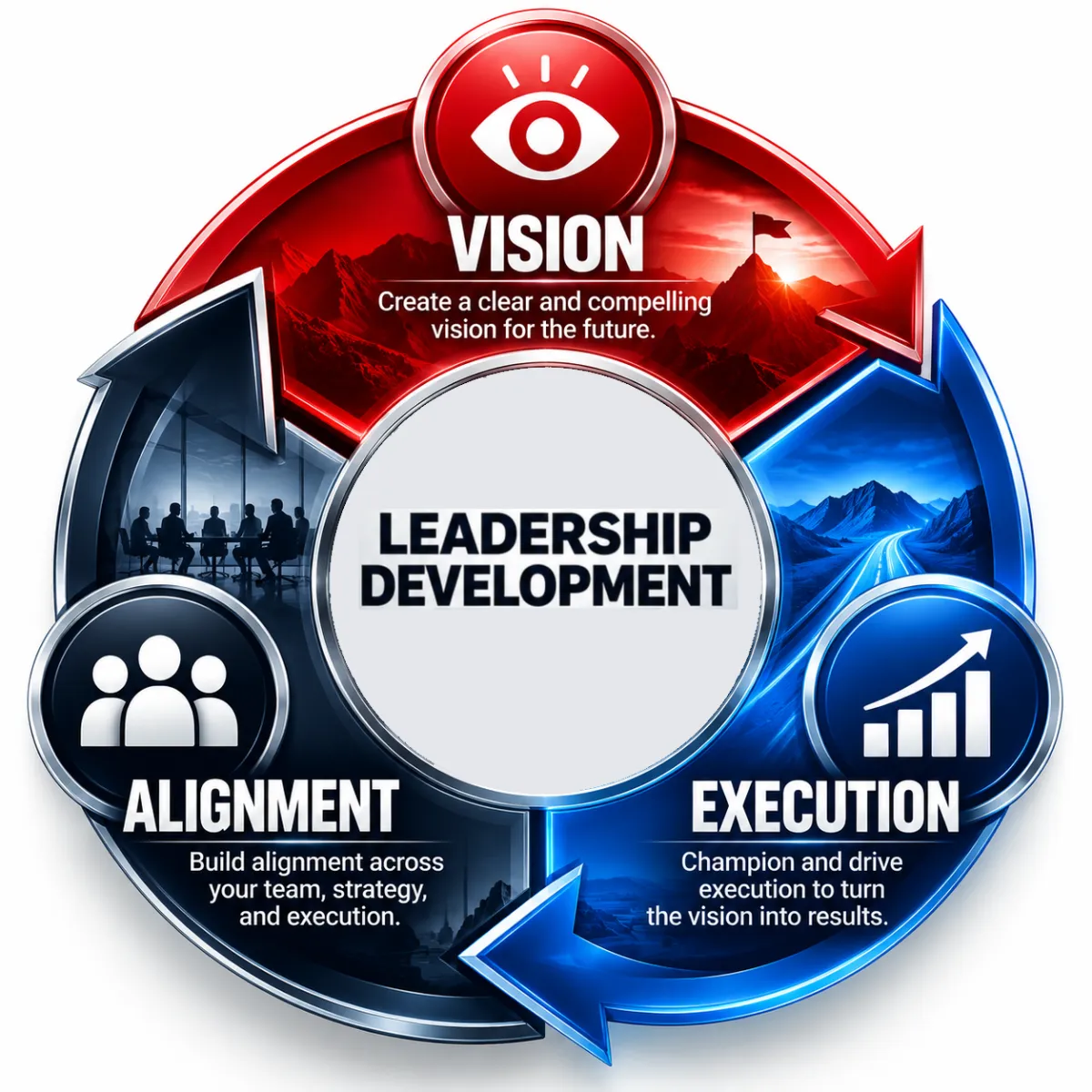
The Leadership Development Plan identifies high-potential leaders and develops their ability to assume meaningful responsibility. The framework concentrates on three leadership practices:
Crafting a vision → Building alignment → Championing execution.
Developing these capabilities allows leaders to take responsibility for increasingly important areas of the company without everything continuing to flow through the founder.
Element 21: Comprehensive Exit Strategy
The final Core Element forces the owner to think beyond today's operations.
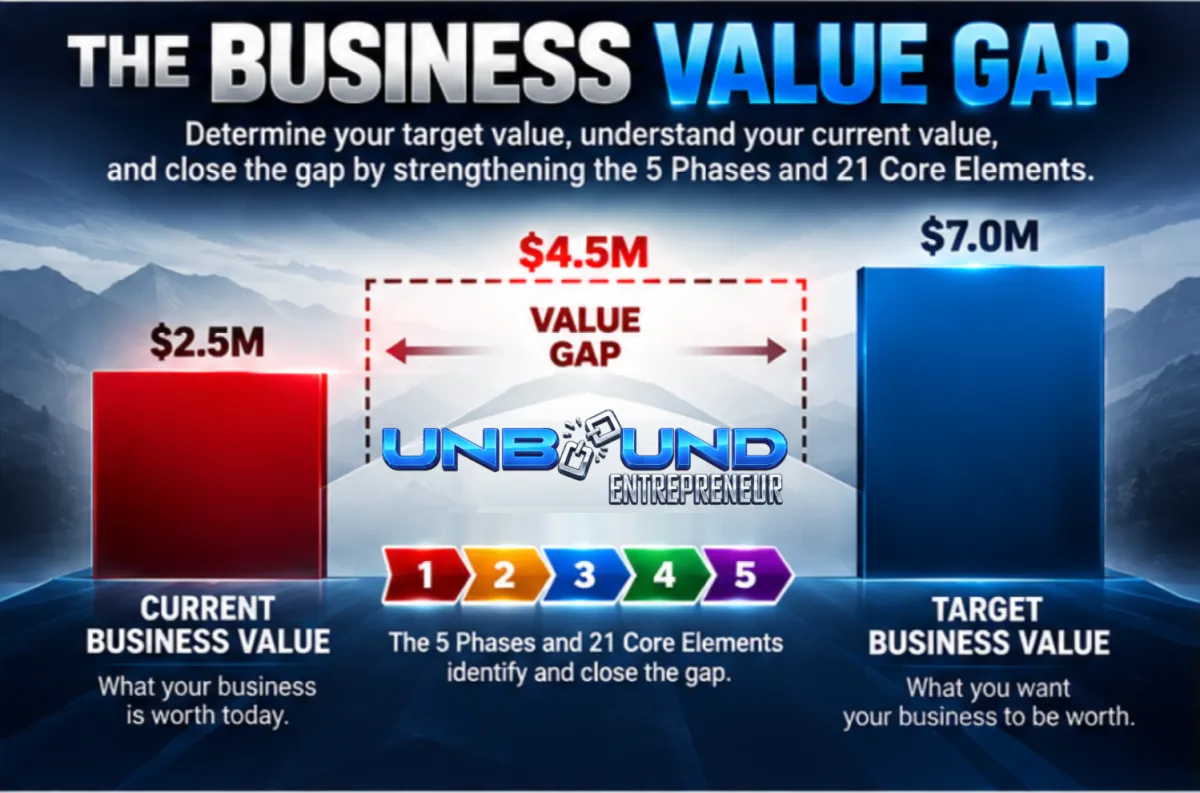
The Comprehensive Exit Strategy begins by determining the target value of the company, comparing it with the company's current value and identifying the value gap between the two.
The owner can then evaluate the company against the 5 Phases and 21 Core Elements to identify areas that remain incomplete or underdeveloped. The objective is a company with stronger cash flow, stronger systems, capable leadership and less dependence on the owner.
An exit does not necessarily mean selling immediately. Depending on the owner's objectives, it could eventually involve succession, restructuring, a merger, or a sale. The framework also anticipates assembling professional advisors, which may include an accountant, attorney and financial advisor.
The Goal
Is Not to Complete 21 Things
The most important idea behind the Unbound Entrepreneur, is that the 21 Core Elements are not a generic checklist that every entrepreneur should attack simultaneously.
The five phases provide context.
A company struggling to reach break-even has different priorities from a profitable company whose founder cannot delegate. A company suffering from uncontrolled payroll growth has different needs from one preparing for succession.
That is why the framework starts with the business's current condition.
The 5 Phases show you where your business is.
The 21 Core Elements show you what needs attention.
Together, they provide a framework for building a stronger, more profitable and less owner-dependent business.
The ultimate progression is simply:
Create the model.
Work through the chaos.
Establish control.
Build prosperity.
Create freedom.
That is the purpose of The Unbound Entrepreneur.

Protection
Your interests come first, always.

Clarity
Honesty and transparency.

Accountability
You get whats promised.